

Last Friday, President Donald Trump announced new modifications to Section 338 tariffs on Canada, marking the second time he has revised the list of imports subject to Section 338 tariffs.
A previous analysis examined impacts from the initial list, and here revisit the topic to see how affected imports have changed since then. While Maine has been the center of attention after Senator Susan Collins took credit for removing some products from the list, there are lots of moving parts both within Maine and throughout the rest of the country.
Using 2025 annual data on imports from Canada, in this post we’ll unpack the revisions to date and look at which states are likely the biggest winners and losers from the revision.
The Section 338 timeline
Before getting into the analysis, here’s a quick recap of key dates that led to this point:
July 20: President Donald Trump announced Section 338 tariffs certain imports from Canada with an August 19 effective date.
Aug. 18: President Trump announced a temporary implementation delay.
Aug. 19: U.S.-Canada trade talks broke down and Canadian Prime Minister Mark Carney vowed “dollar-for-dollar” retaliation.
Aug. 22: U.S. Section 338 tariffs take effect.
Aug. 25/26: Canada publishes, and then revises, its list of retaliatory tariffs with a September 9 effective date.
Sept. 8: Trump revises the U.S. list again and adds some import bans.
Sept. 9: Canada’s retaliatory tariffs take effect.
Sept. 15: Revised U.S. Section 338 tariffs take effect.
Sept. 29: U.S. Section 338 import bans takes effect.
Oct. 23: Trump again revises U.S. Section 338 tariffs with an October 30 implementation date.
Oct. 30: Yet-again-revised U.S. Section 338 tariffs take effect.
The ever-growing value of national covered imports
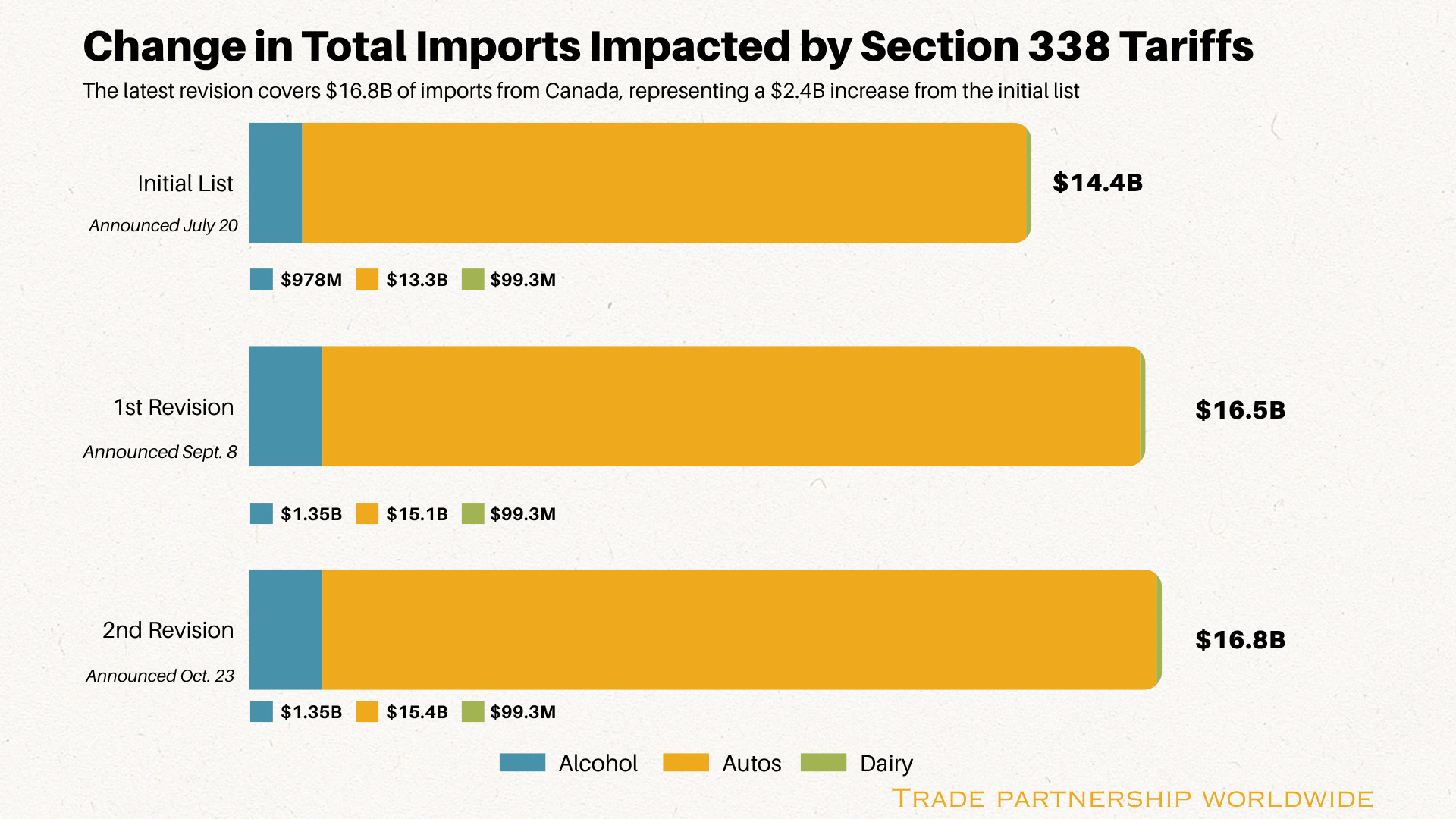
While often framed as swapping some products for others, the value of covered U.S. imports has increased with each revision. The big change occurred from the first revision, when eliminating the carve out for products subject to Section 232 led potential covered imports to jump from $14.4 billion (3.8% of 2025 U.S. imports from Canada) to $16.5 billion (4.3%). The latest revision increased the covered import total by about $300 million to $16.8 billion (4.4%).
State-specific changes show more mixed results
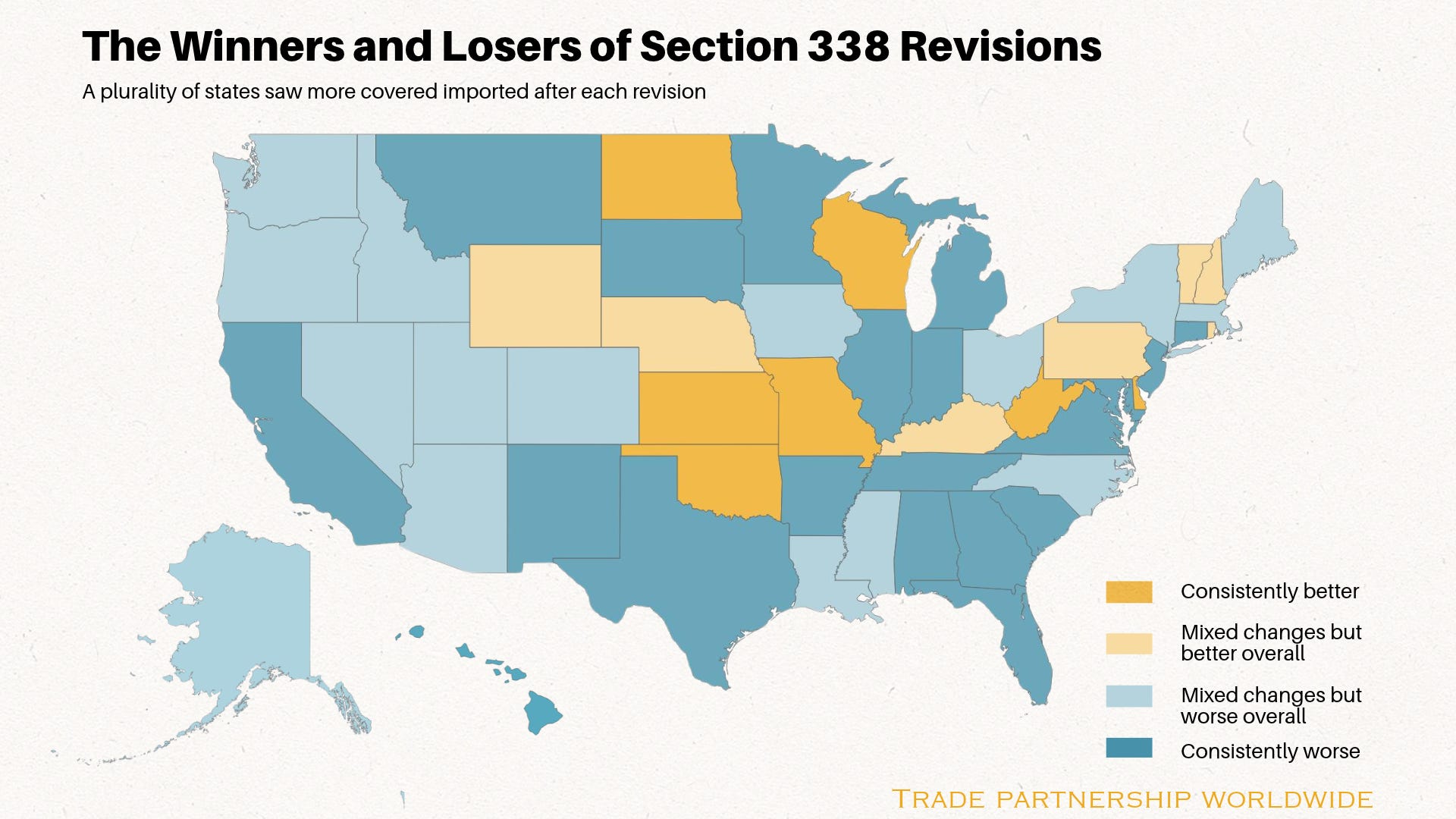
We tracked each state’s changes in affected imports across both revisions. Overall, 36 of 50 states have more imports covered today than when the original Section 338 tariffs took effect. That includes 20 states where the value of covered imports increased with each revision and 16 states saw mixed changes from the revisions but on net ended up in a worse position. Conversely, just seven states saw the value of covered imports decrease with each revision, while nine states saw mixed changes but ended up better off today than at the start. The map below illustrates those changes.
A risky plan if revisions are about swing state elections
Much of the latest revisions coverage focused on Maine exemptions based on the tight election. As the Washington Post editorial board wrote: “There is no economic principle under which a Maine blueberry grower deserves help while a manufacturer in a state without a toss-up Senate race deserves to pay a punitive tax on an equally indispensable Canadian input.”
Yet missed in this coverage is the fact that other other swing states have seen their tariff fortunes worsen due to revisions. Texas and Michigan, two of the most highly contested Senate elections, saw more trade covered by tariffs with each set of revisions:
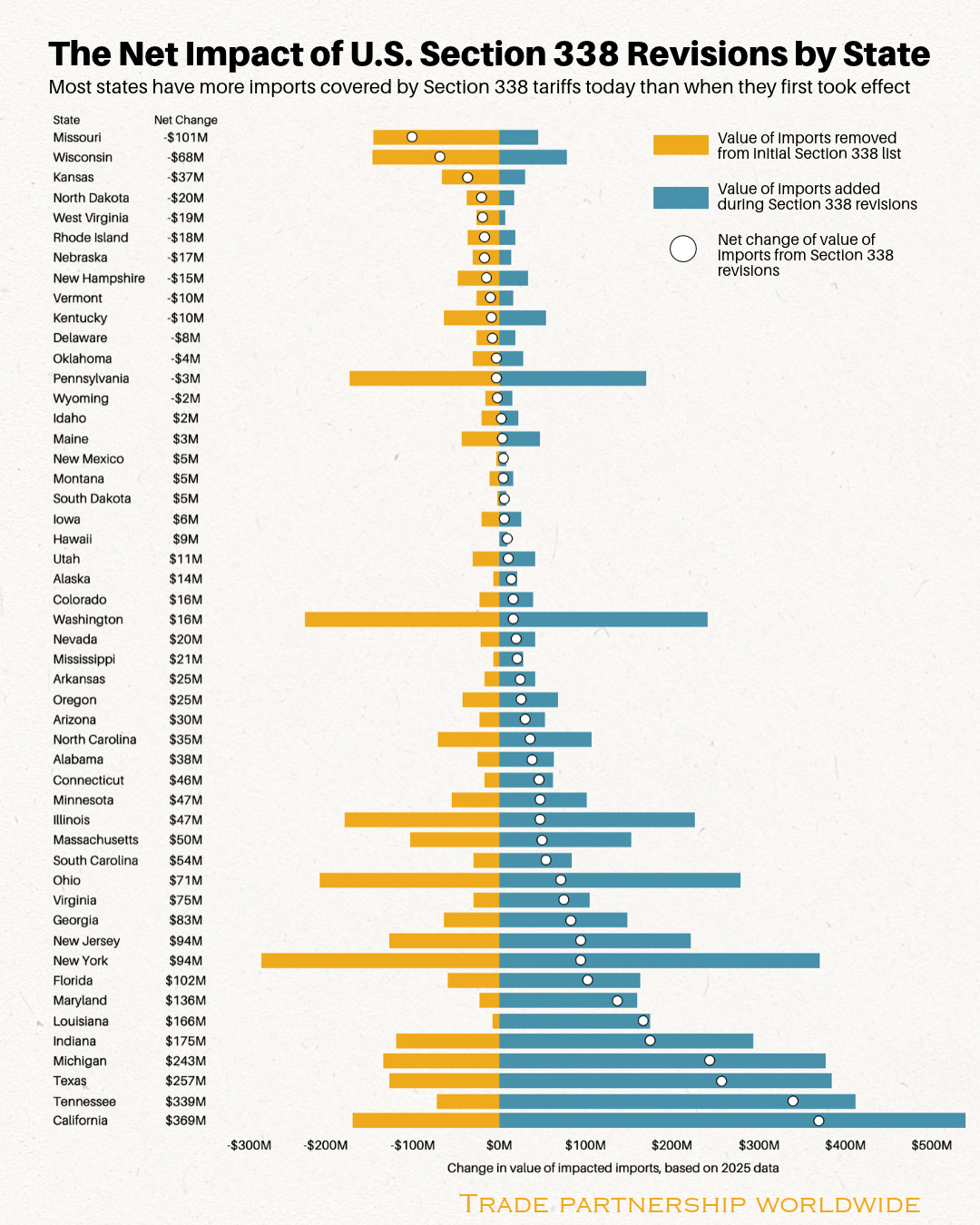
In Michigan, where the Canada tariffs have been a major focus for both the Democratic and Republican candidates, the value of covered imports increased from by an estimated $243 million – from $978 million to $1.2 billion – because of the revisions.
In Texas, the value of covered imports increased by an even larger $257 million – from $821 million to $1.1 billion – due to the revisions.
Revisions aren’t all bad news for other swing state Republican candidates: Kansas was among the few states were each revision saw more tariffs removed than added.
Robbing Portland to pay Presque Isle
Ok, so we don’t know that anyone in Portland is specifically worse off, but another thing missing from media coverage is that Maine’s importers are not universally better off. Between the initial and most recent list, Maine saw a $3.2 million net increase in the value of imports affected by Section 338 tariffs.
Yes, over half of Maine’s $43 million in imports removed from the Section 338 list are products like cardboard boxes, plastic containers and wrappings that are essential for farmers. However, there’s been no coverage of the $46 million worth of Maine’s imports from Canada subject to Section 338 tariffs today that were exempted at the beginning. Much of this burden falls on importers of metal products that are already subject to sky high Section 232 tariffs.
Conclusion
These dynamics – some winners but often even more (or bigger) losers – are in play throughout the country, as shown in the graphic below. While this analysis focuses solely on Section 338 tariffs, the same is true for each of the dozens of new or revised tariff announcements over the last 18 months.