

U.S. President Donald Trump is hosting Chinese President Xi Jinping in Washington, D.C. today for Xi’s first state visit to the United States since 2017. The United States and China have been tariffing (and counter-tariffing, and counter-counter-tariffing) each other for nearly all the intervening period.
After 9 years, the price tag is a staggering $355 billion in extra tariffs – Sections 122, 201, 232, 301, IEEPA – on imports from China since the trade war kicked off in February 2018. That’s based on estimates from TPW’s state tariff tracker, which breaks down tariff costs between those associated with “regular” (most-favored nation) tariffs and those imposed under executive authorities such as Section 301.
Given that cost of living and affordability are the main issue for the second election in a row, and all the attention new tariffs have received, it’s a bit surprising that tariffs imposed prior to 2025 don’t get more attention. The 2018/2019 tariffs have contributed to elevated pricing for years, and there is no reason to expect that to change unless or until those tariffs go away too.
The “Trump” tariffs?
While the phrase has been shorthand, and Trump is responsible for imposing most of the executive authority tariffs, it’s not exclusively a “Trump phenomenon.” President Joe Biden kept most China tariffs in effect despite campaigning against them. Then Biden continued Section 301 tariffs beyond their 4-year statutory termination date, and actually raised some tariffs later in his term. Looking at a graph with the trend data, it’d be impossible to tell when the Trump-Biden transition took place but for the labels. Even after the past 18 months, nearly half of all executive authority tariffs on China — about $165 billion of the $355 billion total — were collected during Biden’s presidency. If you exclude the invalidated IEEPA tariffs, Biden remains responsible for more tariffs on China than Trump.
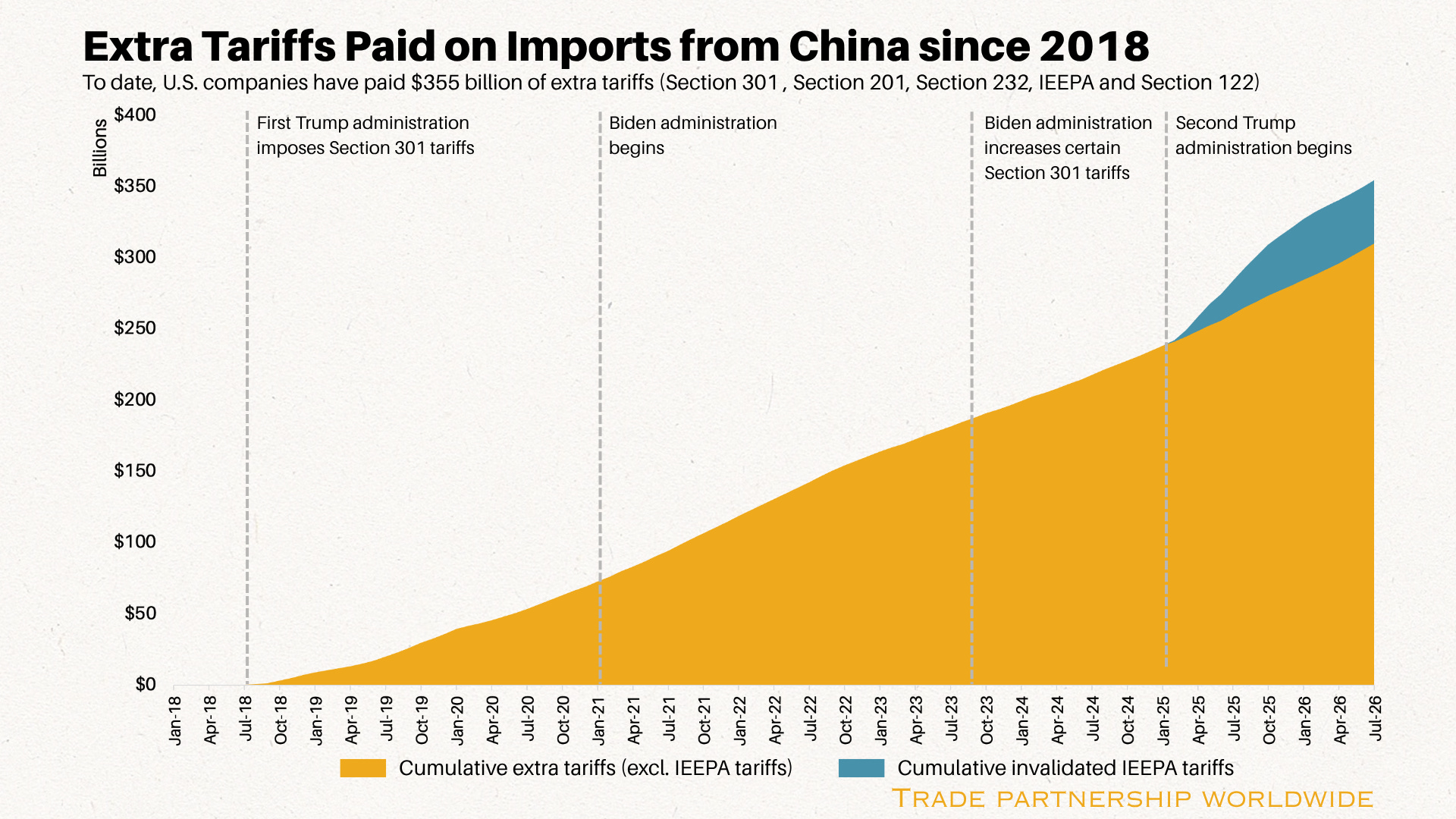
All that said, executive authority tariffs on U.S. imports from China did accelerate rapidly once Trump returned to office. First, there were the 20% fentanyl-related IEEPA tariffs imposed in February 2025. Then, global reciprocal IEEPA tariffs, which for China specifically peaked at 125% in April 2025 before both sides deescalated. Even if excluding all IEEPA tariffs that were struck down, executive authority tariffs on China keep rising to the tune of about $150 million per day/$1 billion per week in July (latest month available).
Key state impacts
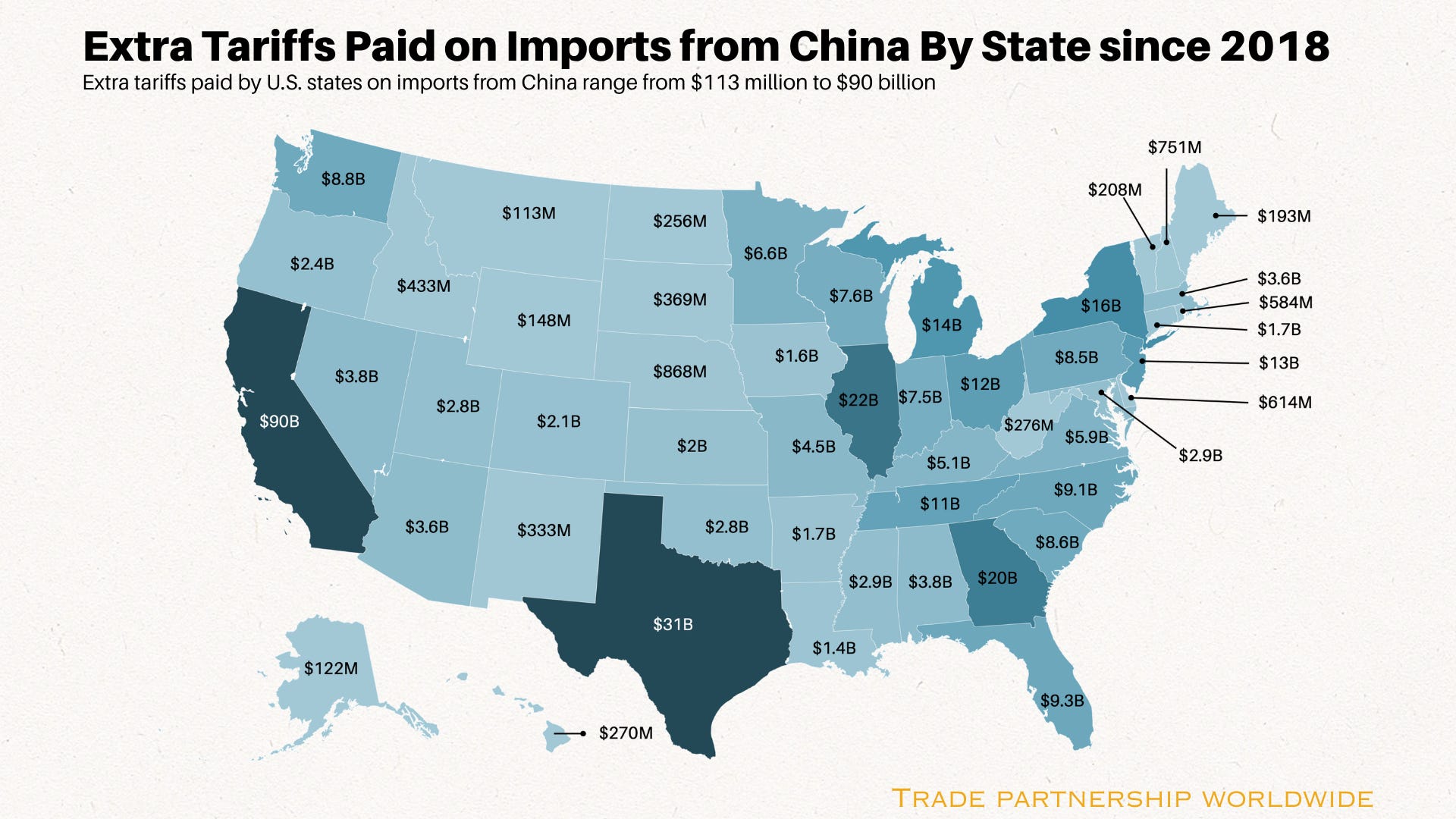
Estimated tariff costs on imports into individual states vary greatly from a low of $113 million for Montana to approximately $90 billion for imports into California. The types of products seem almost as random as the tariff costs seem arbitrary:
$43 million on imports of transmission shafts into Nebraska
$70 million on imports of glasses and goggles into Rhode Island
$32 million on imports of turbojets and other turbines into West Virginia
$1.3 billion on imports of plastic flooring tiles in Georgia
High costs, but to what end?
The $350 billion paid to date, and another $1 billion or so each week, begs the question: are the costs worth it? Reasonable people can disagree about a lot of things, but the results here seem underwhelming (at best).
The Section 232 steel and aluminum tariffs imposed in early 2018 clearly didn’t revitalize the U.S. metals industry. If they had, new Section 232 steel and aluminum tariffs and derivative products wouldn’t have been needed in 2025.
The Section 301 tariffs clearly didn’t change China’s policies or behaviors. If they had, Biden wouldn’t have needed to continue them and Trump wouldn’t be looking to extend them again.
To the extent Section 301 tariffs shifted certain supply chains out of China, the imports from other countries often were hit with subsequent new tariffs. Congress’ failure to renew the GSP program in 2020 particularly affected companies that shifted supply from China to Southeast Asia for the GSP tariff advantage. Later, global IEEPA/122/forced labor tariffs in 2025/2026 raised taxes on imports from those GSP and other countries too — causing some companies to return to China after all.
Other metrics, such as the increasing U.S. manufacturing jobs and the shrinking goods trade deficit have also gone in the opposite direction of what tariff supporters would consider success.
Some limited relief on the way?
Details on the proposed “Board of Trade” would be a potentially useful outcome of the Trump-Xi meetings this week. POLITICO reports there could be details on “targets for future tariff cuts,” but also that “private sector lobbyists now worry the administration is coalescing around a much narrower package of tariff reductions, like those granted during Trump’s first-term trade war.”
With a high-end target of exempting up to $30 billion in imports — not tariffs — even a successful Board of Trade would leave the vast majority of extra tariff costs in place for the foreseeable future. And these reductions could be more than offset by any number of China-specific or global tariffs at various stages of review.
Perhaps “do no harm” is the best that U.S. importers from China (and their customers, both American manufacturers and families) can hope for.