

Today, the House of Representatives will take the first step toward considering a new Russia sanctions bill that would authorize the president to impose tariffs of up to 100% on goods imported from countries meeting certain criteria. The Senate passed the bill by a vote of 86-11 last month.
President Trump has not been shy about using any and all tariff statutes – and this bill is a top White House priority despite congressional Republicans’ misgivings – so it’s hard to imagine this new authority gathering dust on the shelf. This post attempts to estimate potential new tariff exposure and how burdens may vary between different U.S. regions.
Which countries will be affected?
The inability to answer this definitively is one of the big concerns about the bill. Tariffs could be imposed with little more more than presidential notification on countries deemed among the top five:
Buyers of Russian crude oil;
Buyers of Russian natural gas (and accounting for at least 15% of all such Russian exports), and/or
Facilitators of “Russian oil sanctions evasion.”
The definition for the last one is particularly vague, but even for oil and gas it is not so straightforward. The analysis will be updated frequently, meaning reduced purchases by one country may lead to new tariffs on another. If the #6 purchaser reduces their imports, they could become subject to tariffs anyways if #5 reduces purchases even more. And #5 may remain subject to tariffs if still considered a top facilitator of Russian evasion.
Or not… the President can waive the tariffs too! In the end, it looks like a new effort to create negotiating leverage through tariffs. A potential replacement to IEEPA and Section 122 tariffs that ended earlier this year, or supplement for Section 232, Section 301, and Section 338 tariffs that are (or could be) subject to court challenges.
While we can’t be sure, conversations with those following the bill closely suggest the following countries are at the most risk of new tariffs: China, India, Brazil, Hungary, Japan, Korea, and Turkey. As such, our analysis covers those seven countries. For simplicity, we used 2025 data even though the bill calls for analyses based on the prior 12 months. Perhaps we’ll update the analysis if the bill becomes law or is evoked for specific countries.
Authorizing $700+ billion in potential new tariffs, including on allies
In 2025, the United States imported $739 billion in goods from those seven high-risk countries for Russia secondary sanctions, or about $1 out of every $5 of imports. The statutory rate makes the math quite simple: a 100% tariff on $739 billion in imports means $739 billion in potential tariffs — a staggering figure compared to the approximately $270 billion in U.S. tariffs imposed in 2025. In reality, import declines would lead to much lower tariff costs, and as past tariffs have shown — there are likely to be certain product exemptions, and perhaps different country-specific rates.
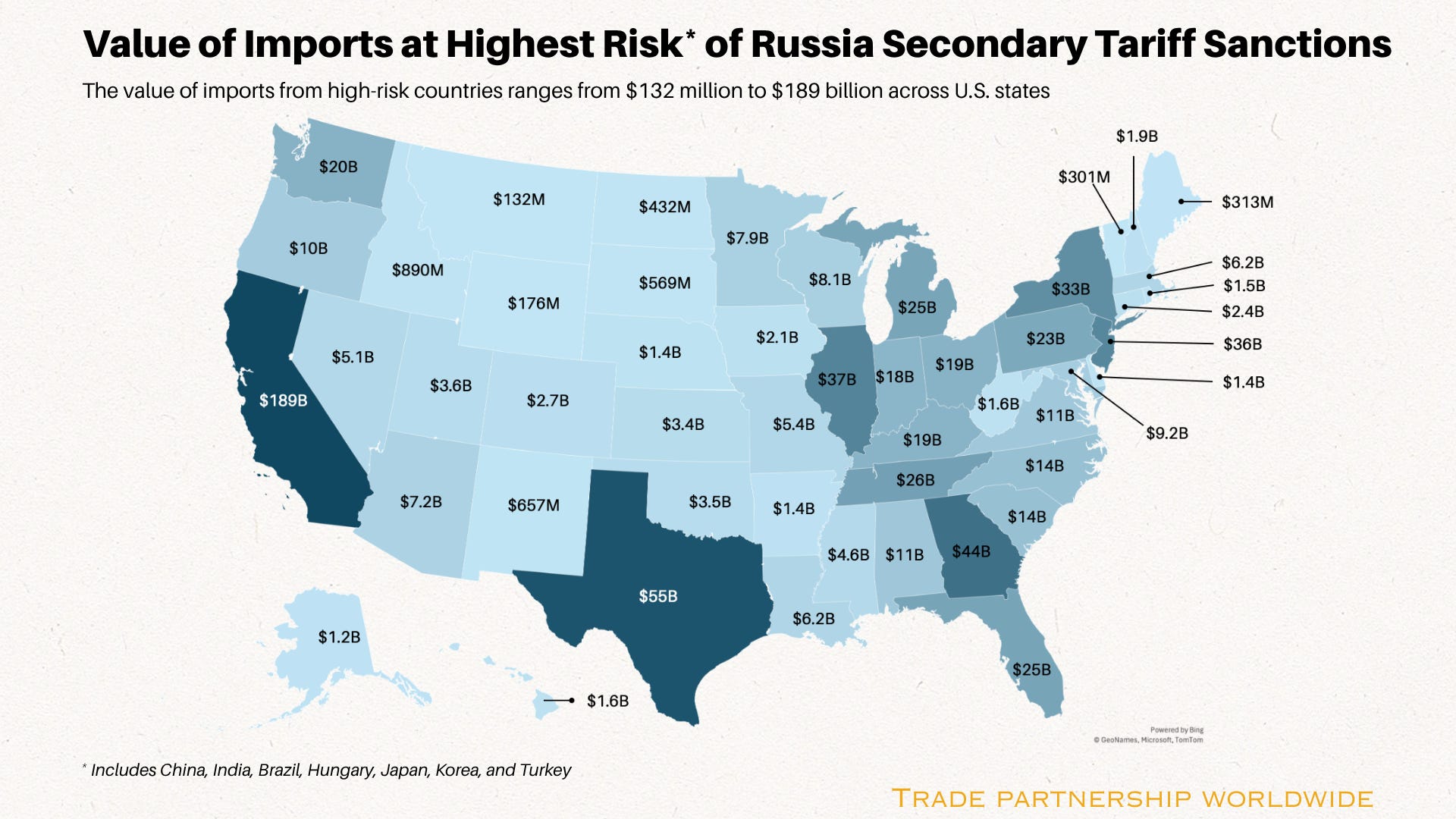
The states with the most imports from high-risk countries are California, Texas, and Georgia. California is not only the biggest state importer from all sources, 35% of its imports come from at-risk countries. That is well above the 22% national average.
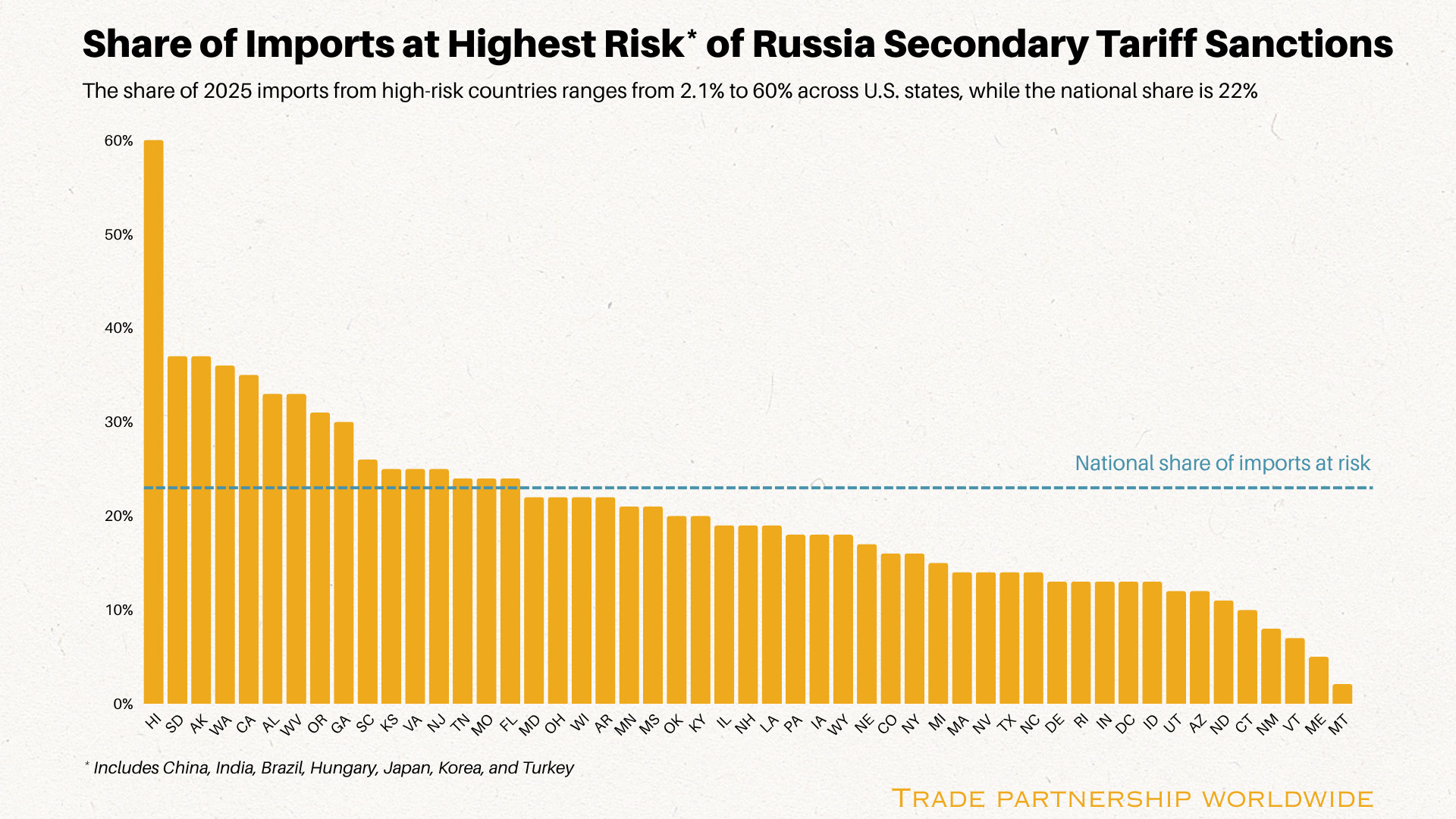
Looking solely at the share of total imports from high-risk countries, Hawaii stands alone at 60%, nearly three times higher than the national average of 22%. A diverse mix of states then fall into a few bands:
35-37% of imports: South Dakota, Alaska, Washington, California
30-33% of imports: Alabama, West Virginia, Oregon, Georgia
24-26% of imports: South Carolina, Kansas, Virginia, New Jersey, Tennessee, Missouri, Florida
At the other end of the spectrum is Montana, for which the high-risk countries account for just 2% of imports.
States with the highest value of high-risk imports
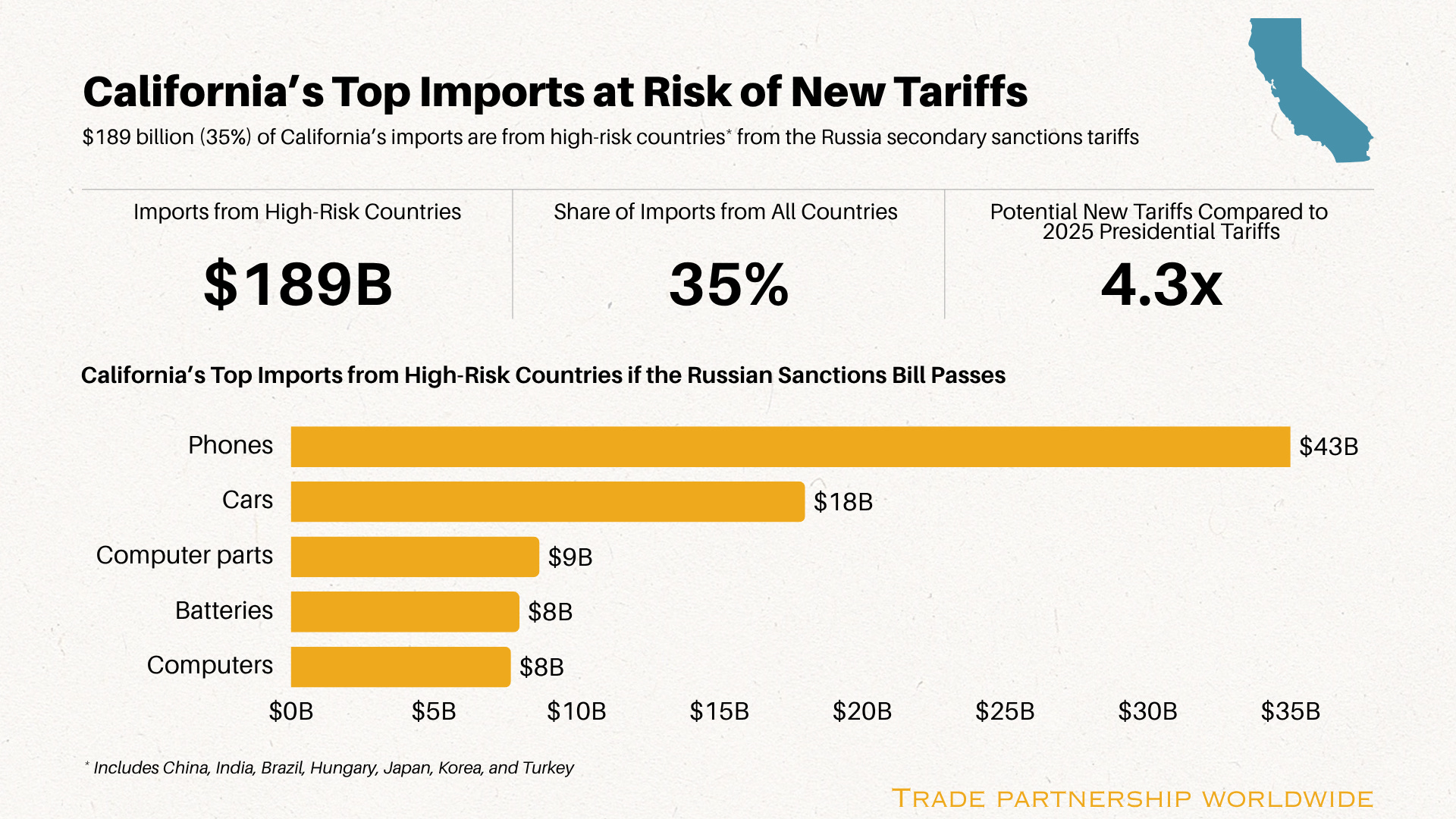
California: as noted above, California is not only the biggest state importer in the United States, it also has one of the highest shares of imports from high-risk countries. As a result, its at-risk import value exceeds the next four states combined (unlike, says, Section 338 tariffs on Canada). Cell phones are far and away the top at-risk import into California.
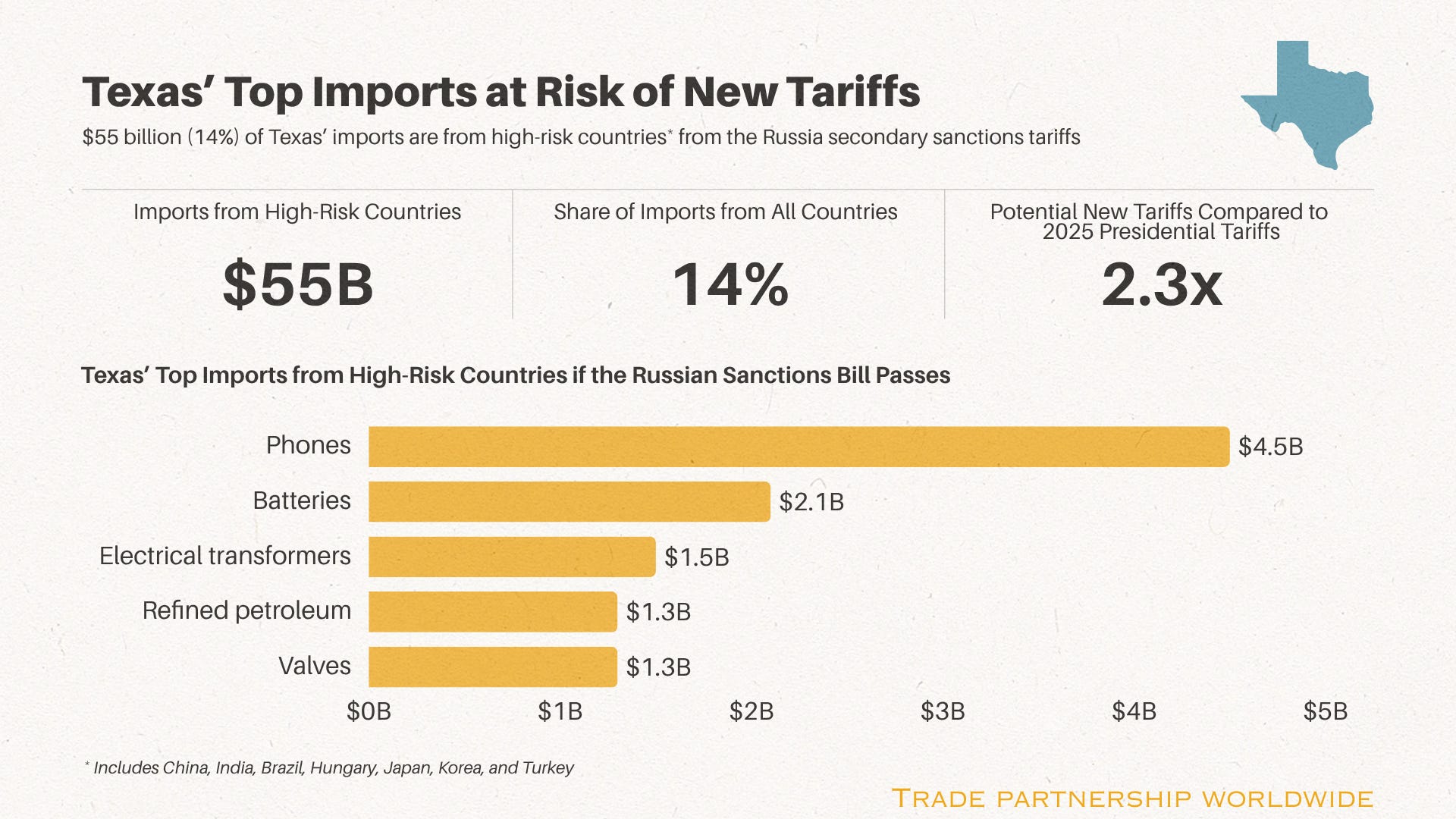
Texas: Texas only makes the list due to its high overall imports, as the high-risk countries’ share of its total imports is well below the national average. Once again, phones lead the way, followed by batteries and transformers.
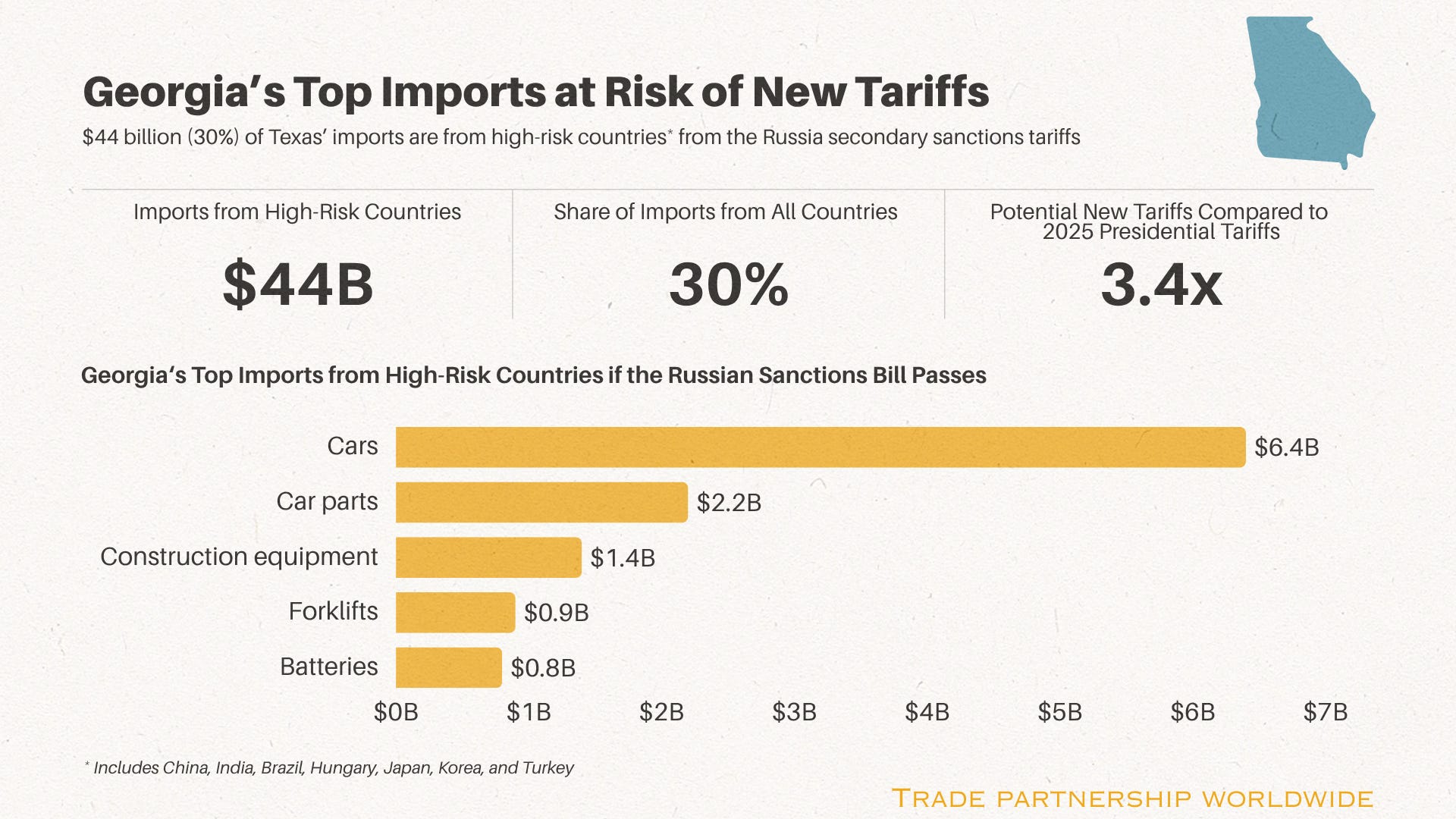
Georgia: Georgia is the sixth-largest importer overall but leapfrogs several others in terms of potential here because of its high share (30%) of imports from high-risk countries. Autos and auto parts top its import list, followed by industrial equipment.
States where high-risk imports account for the greatest share of total imports
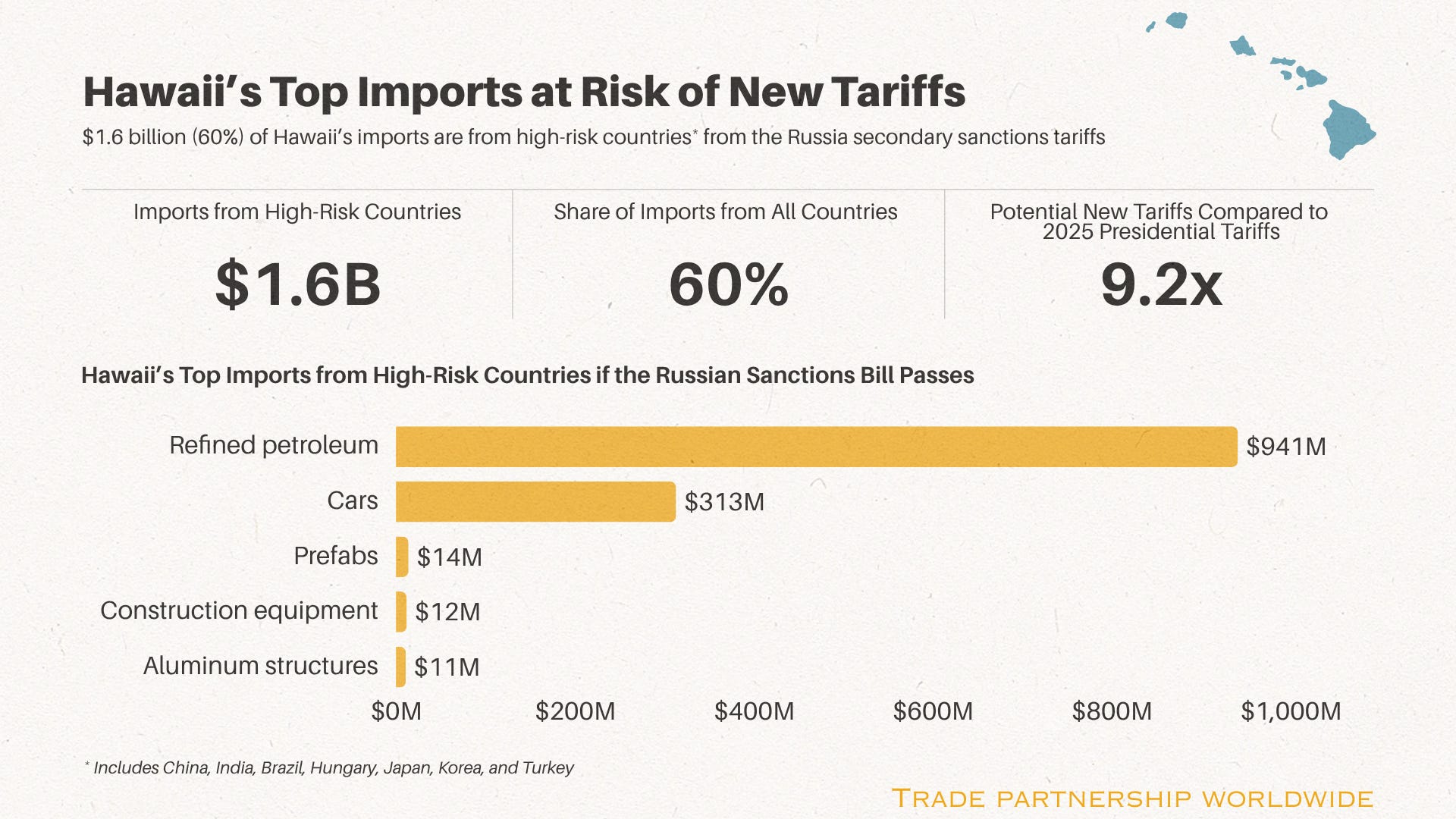
Hawaii: by a very wide margin, Hawaii has the highest share of imports from high-risk countries, driven largely by imports of refined petroleum products. Bad news for a state that typically has some of the highest gas prices in the countries ($5.40/gallon for regular and $6.93/gallon for diesel as of writing). That said, energy products have been exempted from most tariffs to date, and could be again.
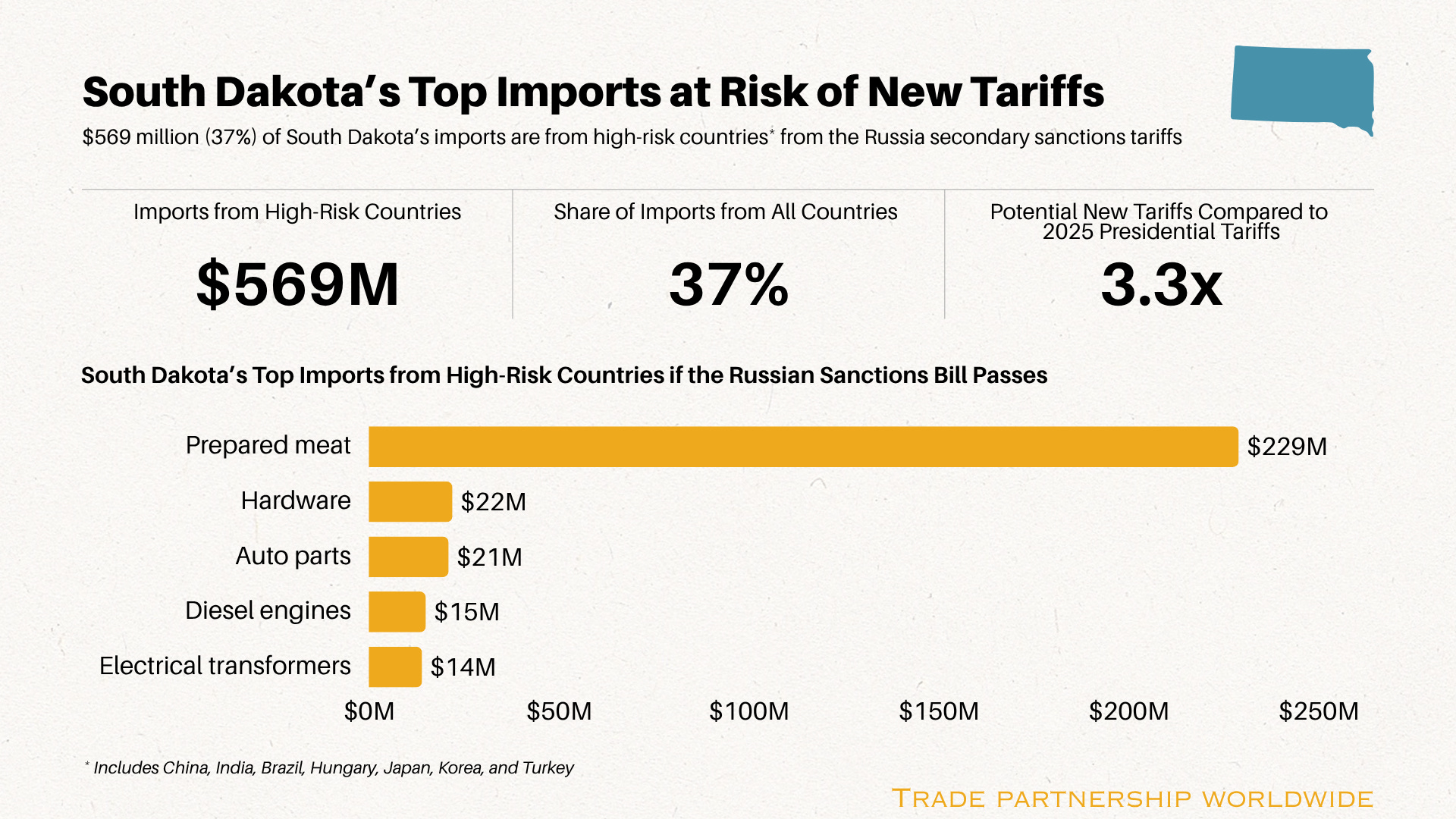
South Dakota: like many smaller states, a single product often explains a lot of the impact. In South Dakota’s case, that product is prepared meat (e.g., beef jerky). Beef prices have received outsized attention, and so beef products have benefited from certain tariff exemptions as well, though South Dakota’s other imports likely wouldn’t be so lucky.
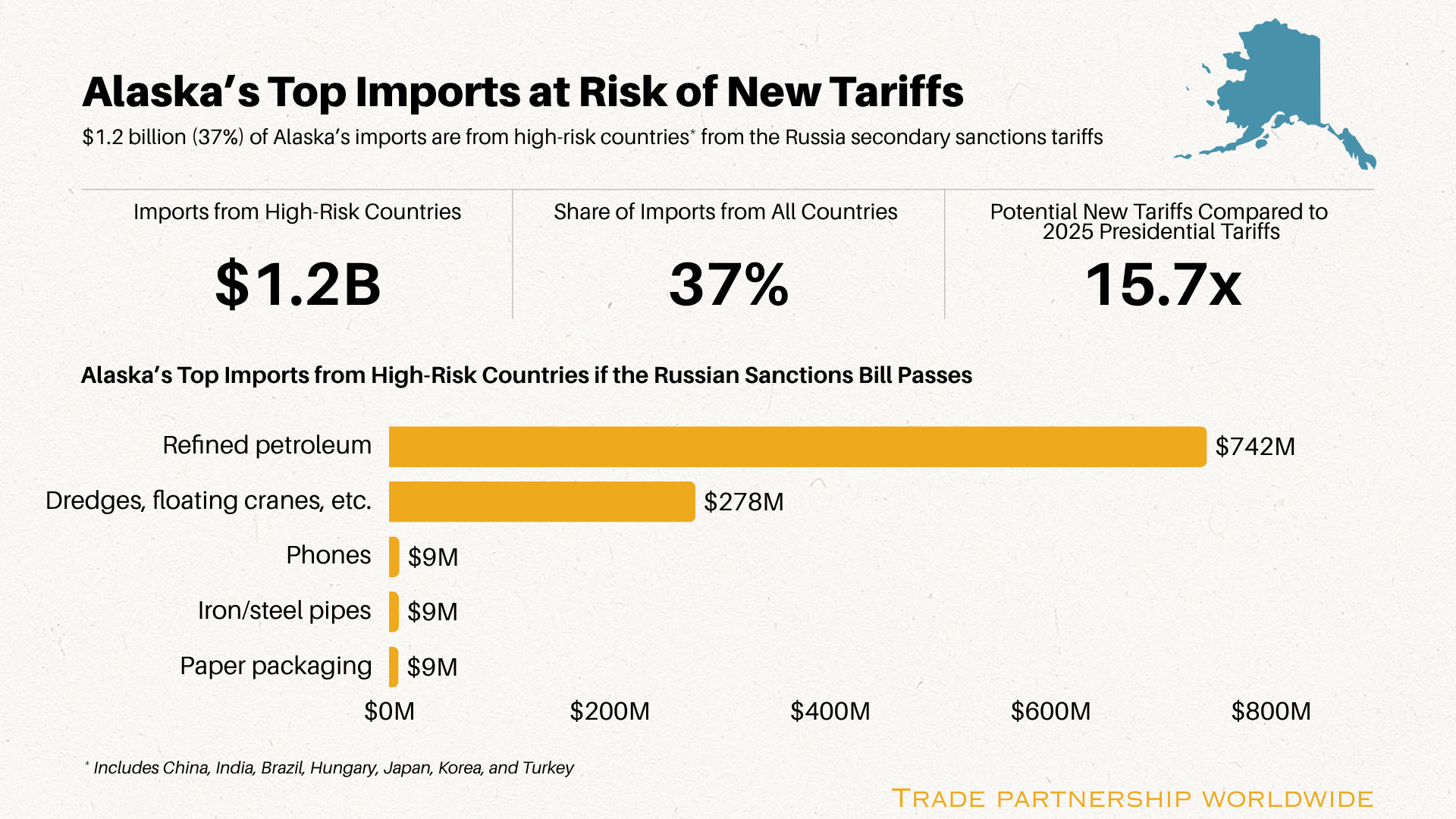
Alaska: Alaska’s high share of at-risk imports is also attributable to refined petroleum products, and therefore could be spared some of the harsher tariff impacts by a continuation of exemptions for energy products. Boats may therefore be the product where Alaskan companies and individuals would see the greatest costs associated with potential future tariffs.
Conclusion
No one exactly when or how tariffs could be implemented as secondary sanctions should the Russia bill be enacted into law as currently drafted. Yet as the numbers show, the explicitly authorized tariffs could be very large, and serve as a de facto ban on a number of critical imports for American companies and consumers. Even if the tariff rate is a uniform 100%, the burdens won’t be shared so evenly.
States that avoid new import tariffs aren’t necessarily off the hook forever. As Canada’s Section 338 retaliation shows, trading partners may not be willing to accept new U.S. tariffs indefinitely. Today’s tariff winners may be the tomorrow’s target.