

Last night, the White House published initial details of the U.S.-China Board of Trade products and procedures. The list of U.S. products eligible for tariff reductions — let’s call them “BoT products” — is mostly household items such as linens, plastic kitchenware, small appliances, toys and games, and sporting goods. Like all things in trade, those selections drive regional differences for expected impacts.
A few notes at the national level…
First off, it’s important to note that tariffs don’t go away immediately. These are simply products recommended for future reductions. We recently estimated $355 billion in extra executive authority tariffs on imports from China through July 2026 — no tariffs contributing to that estimate have been reduced or eliminated as a result of this announcement. It would take a future action to implement actual changes.
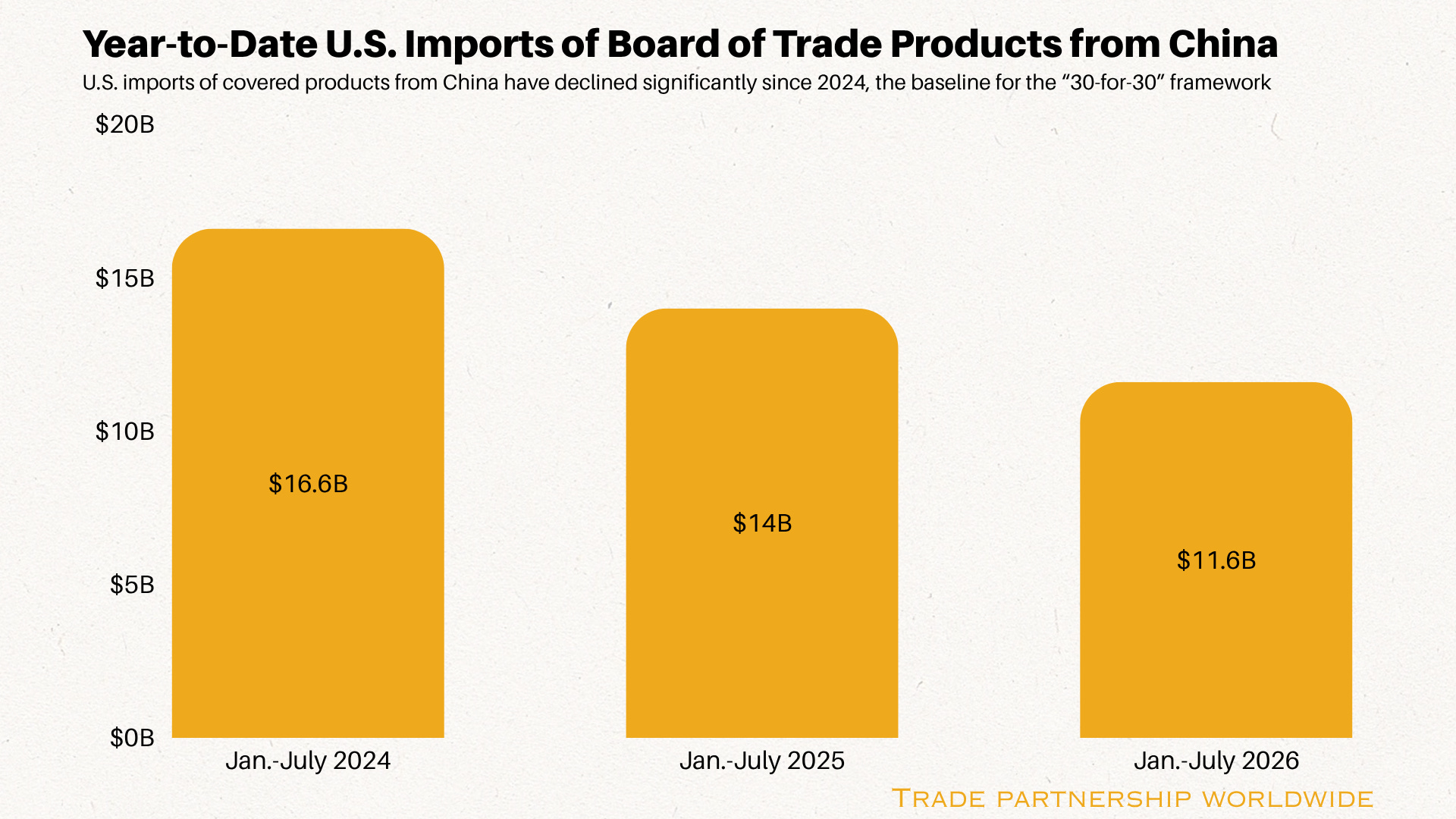
Second, the “30-for-30” framing is misleading since it is based on 2024 trade data. Both U.S. exports to and imports from China have declined significantly since then. This is easiest to see using January-July (latest available for 2026) data to get an apples-to-apples comparison. As the graph below shows, U.S. imports in 2026 are about 30% lower than 2024 levels. Some tariff lines are only partially eligible, so the actual value of 2026 trade that might be eligible is more like $20 billion or less. (This is harder to do for exports, as explained here, but perhaps we’ll try in the future.)
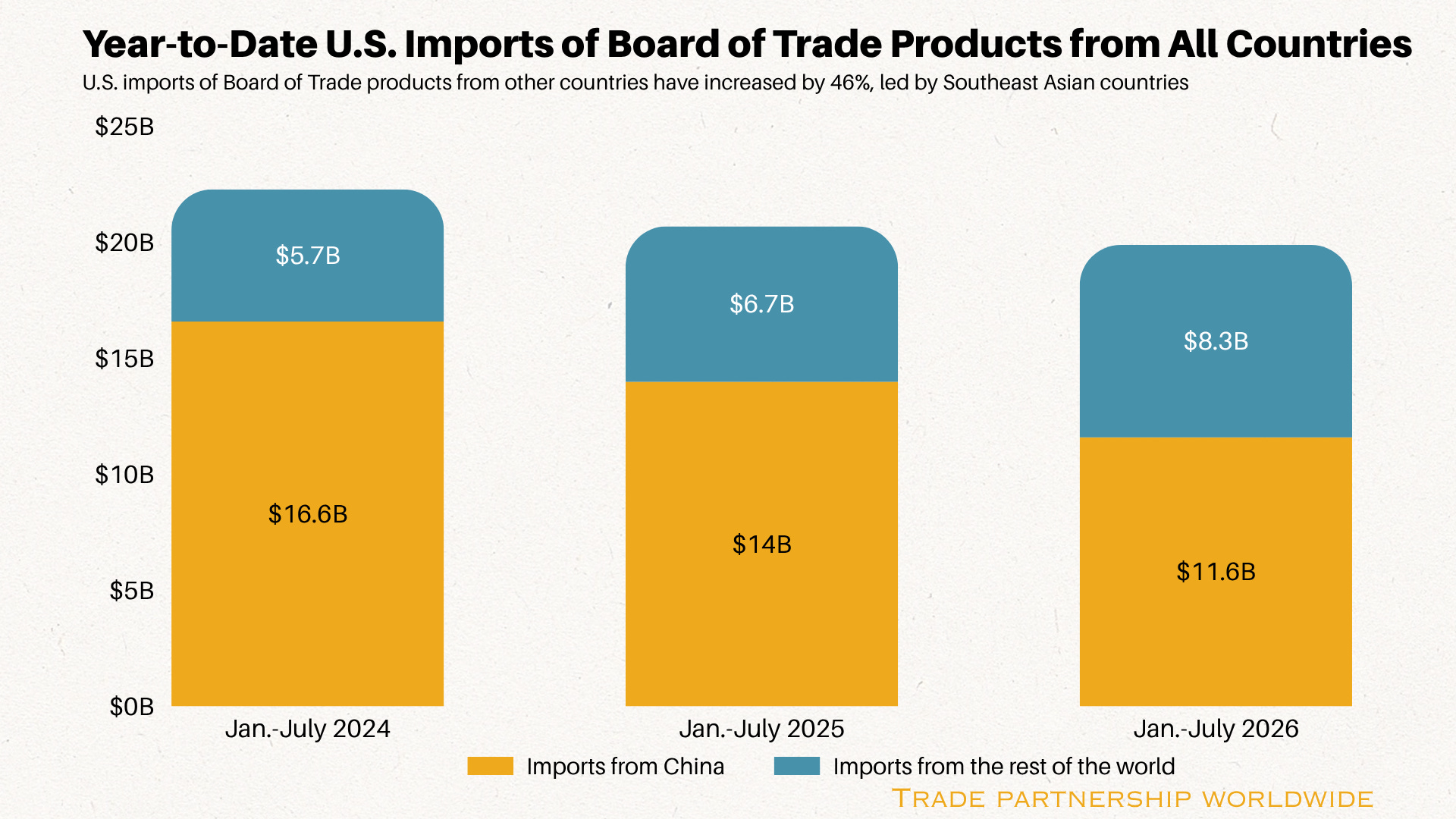
Third, the biggest “losers” might be importers whose products are on the list — but who moved supply chains out of China in the last 18 months. The “leave China” message has been loud and clear, but those companies that heeded it now find themselves at a competitive disadvantage to those who stayed. The revised version of the first chart shows imports from the rest of the world, which grew 46% from year-to-date 2024 to 2026.
Tough luck if your new supplier is now significantly more expensive than your old one — you gotta crack a lot of eggs to make a managed trade omelette. BoT product import growth was led by imports from Vietnam (+$1.3 billion, +108%), Thailand (+$377 million, +163%), Indonesia (+$340 million, +79%), and Cambodia (+$249 million, +688%).
Looking at U.S. state impacts, there are once again huge discrepancies based on the BoT product selections.
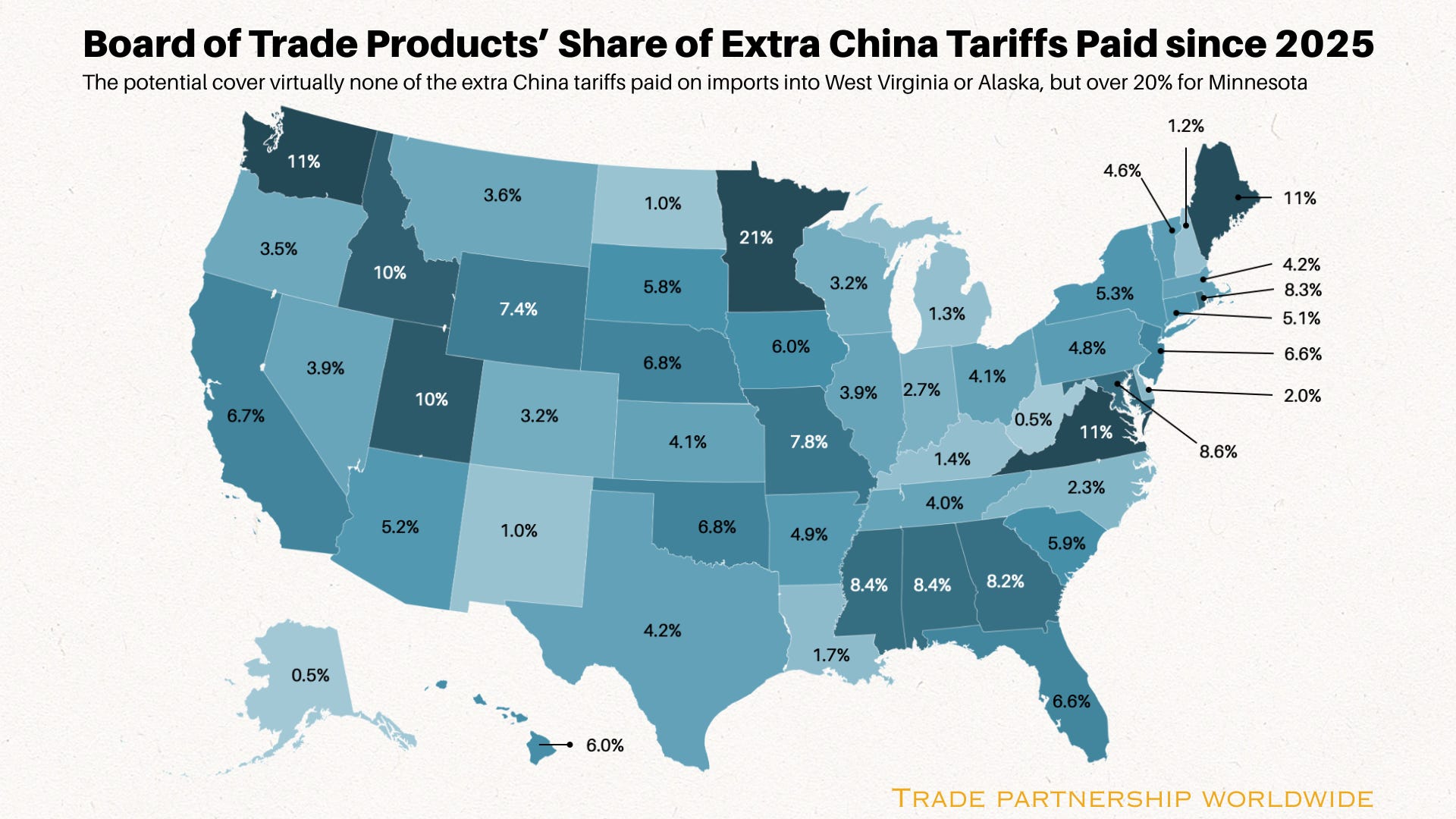
Minnesota importers are the biggest winner. Using all available 2025-2026 data, Minnesota was the 2nd largest importer of BoT products despite being just the 15th largest importer from China. The BoT products accounted for nearly one-third of Minnesota’s imports from China and one-fifth of executive authority tariffs paid. In both cases, these are nearly four times the national average. Toys and games and child safety seats explain most of Minnesota’s potential savings.
West Virginia and Alaska importers will see virtually no impact. In each case, the BoT products account for less than 1% of imports from China and just 0.5% of the presidential tariffs paid on imports from China since January 2025. That’s not to say there could be no consumer benefits — toys or household goods imported into other states may be sold there at lower prices if and when tariffs are reduced — just that the types of products imported directly into the states are unlikely to benefit from tariff cuts.
The “losing from inclusion” phenomenon is easiest to spot in small states like Idaho. In the first seven months of 2024, China accounted for virtually all of Idaho’s umbrella (98%) and small appliance (99.8%) imports. For the same period in 2026, 87% of Idaho’s umbrella imports came from Indonesia and 60% of its small appliance imports came from Thailand. Finding and qualifying new suppliers involves real costs, both in time and money. Unwinding decisions if the new suppliers are not longer competitive, or simply less profitable, could cost even more. At the end of the day, it could be years of headaches and lost opportunities to end up right back where things started. These conversations are happening today at companies across the United States.
Conclusion
The prospect of tariff reductions is undoubtedly good news for U.S. companies that continue to import these products from China. Yet the product coverage is quite limited, so most importers are not affected. Perhaps unwittingly, the reductions could cause even greater harm to companies that tried to follow the U.S. government’s guidance to reduce reliance on China.