

Today, we’re looking at potential U.S. state impacts of Canadian retaliation based on export values from 2025. This builds on yesterday’s analysis of covered export shares. While using export values tends to return the same big states – California, Texas, Florida – the Canadian retaliation impacts show a different trend.
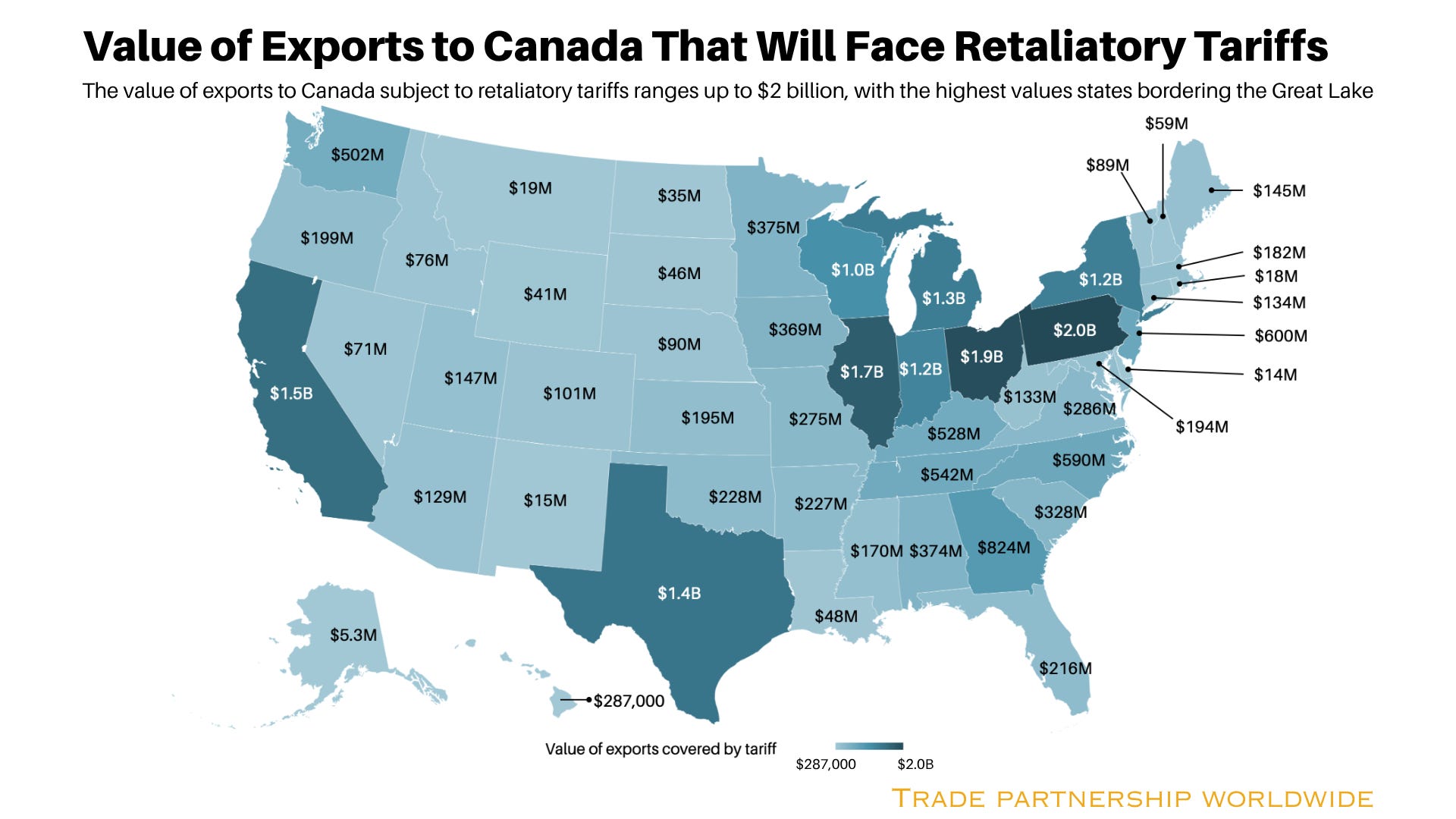
The heat map below clearly shows the concentration of impacts around the Great Lakes. In fact, 7 of the 9 states with at least $1 billion in potentially affected exports, only California and Texas do not border one of the Great Lakes (whatever they happen to be named).
Pennsylvania (feel free to skip to Ohio if you read yesterday’s post)
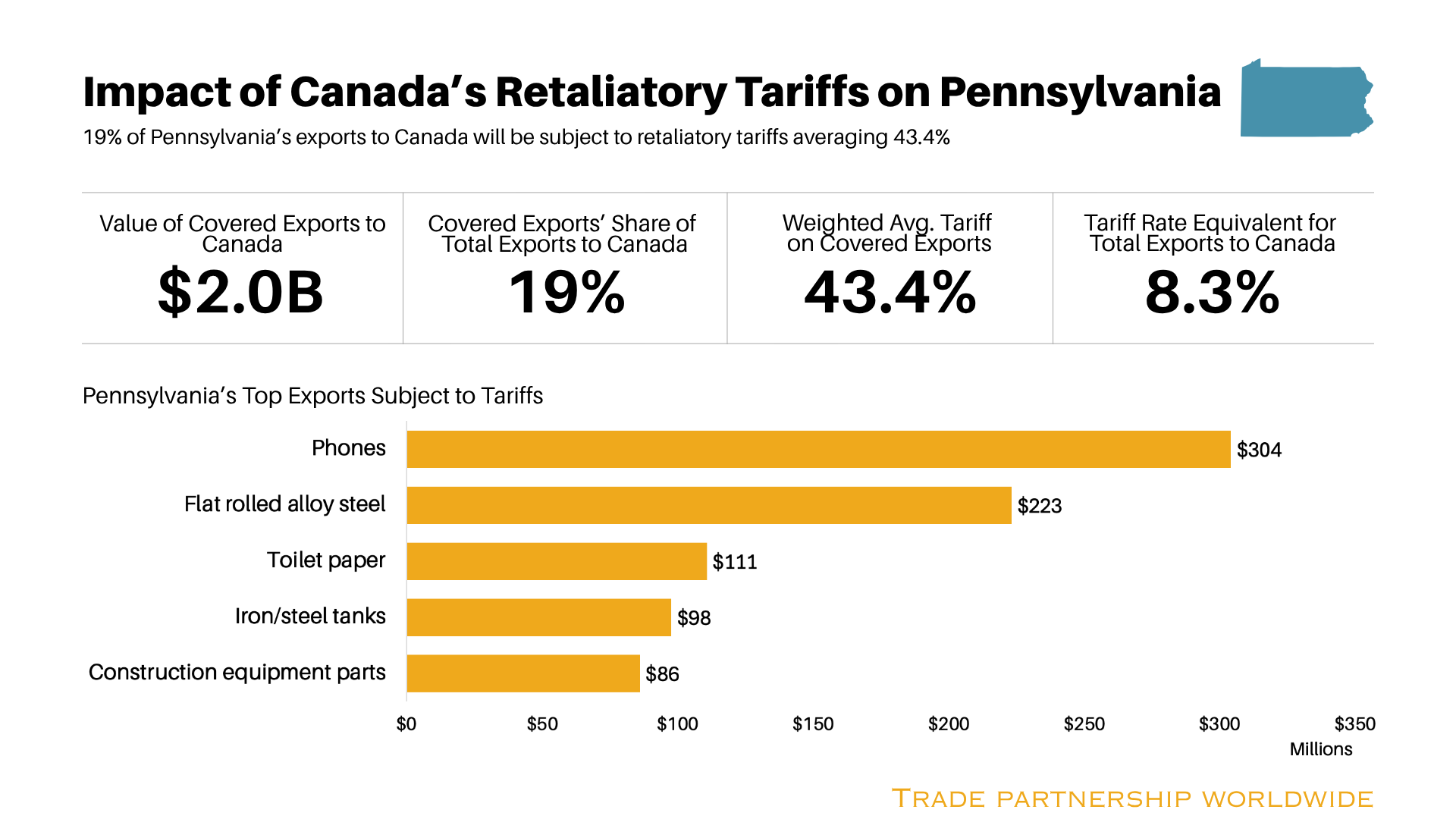
Pennsylvania has the highest value of exports subject to retaliation at $2.0 billion for U.S. Section 338 tariffs. The 43.4% effective rate on covered exports ranks 9th among all states. Overall, Section 338 retaliation is equivalent to an 8.3% universal tariff on Pennsylvania’s exports to Canada, among the highest in the country. Key affected Pennsylvania exports include phones, flat-rolled alloy steel, toilet paper, iron and steel tanks, and construction equipment parts.
Phones are an interesting case where using raw U.S. export data would show much bigger impacts on Pennsylvania exports. Publicly available state export data include both exports of U.S. made goods and re-exports of foreign-made goods. But most U.S. phone exports are re-exports, and Canadian retaliation only applies to U.S. made goods. Accounting for these nuances is just one of the steps undertaken for this analysis (to be discussed in greater detail later this week).
Ohio
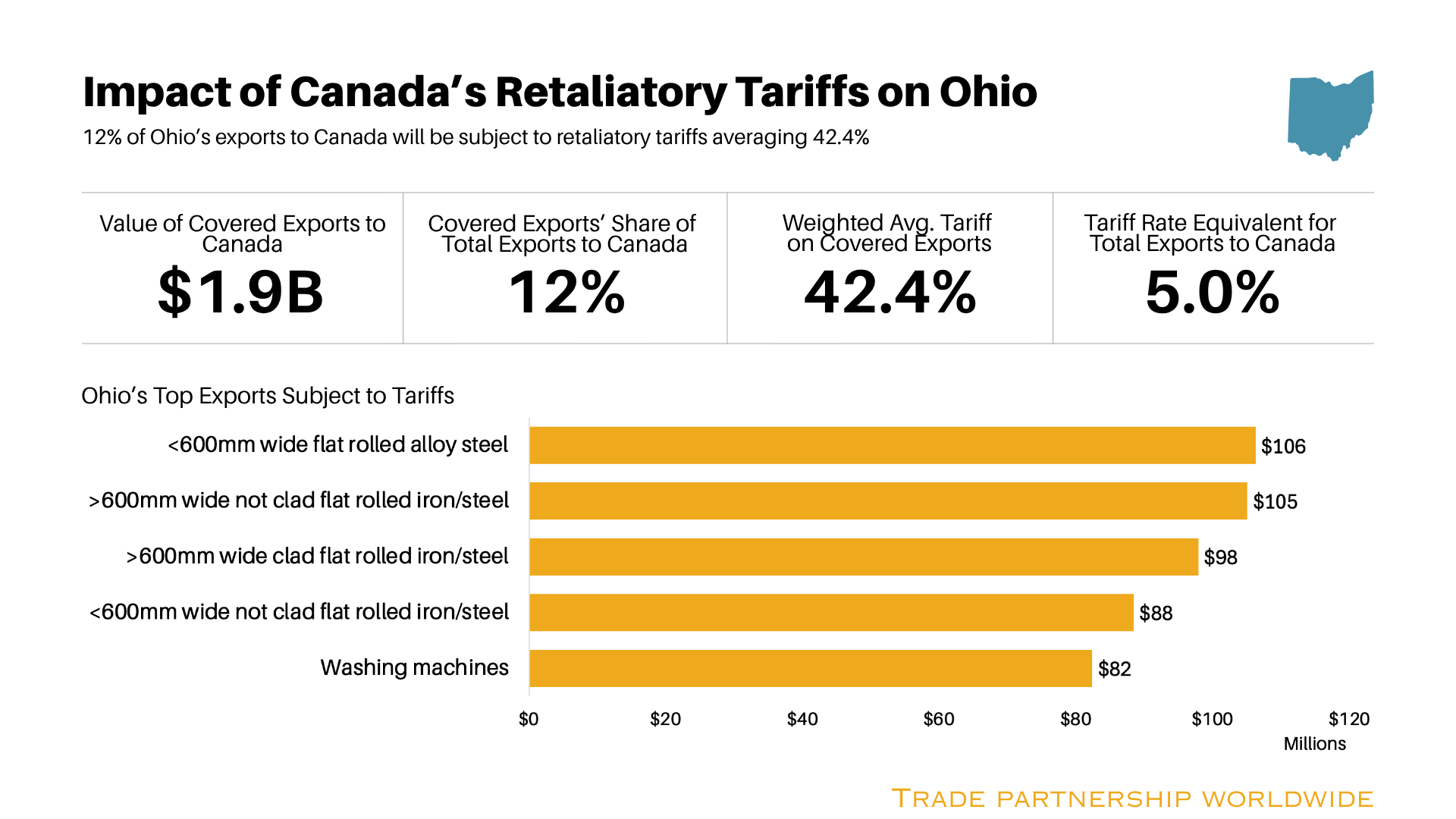
Ohio exported $1.9 billion in covered products to Canada in 2025, 2nd among all states. The 42.4% effective rate on covered exports ranks 14th among all states, meaning that more of its exports face the 15% or 25% rate than Pennsylvania. Overall, Section 338 retaliation is equivalent to a 5.0% universal tariff on Ohio’s exports to Canada. The top four exports are all types of flat-rolled iron and steel, with washing machines rounding out the top five.
Illinois
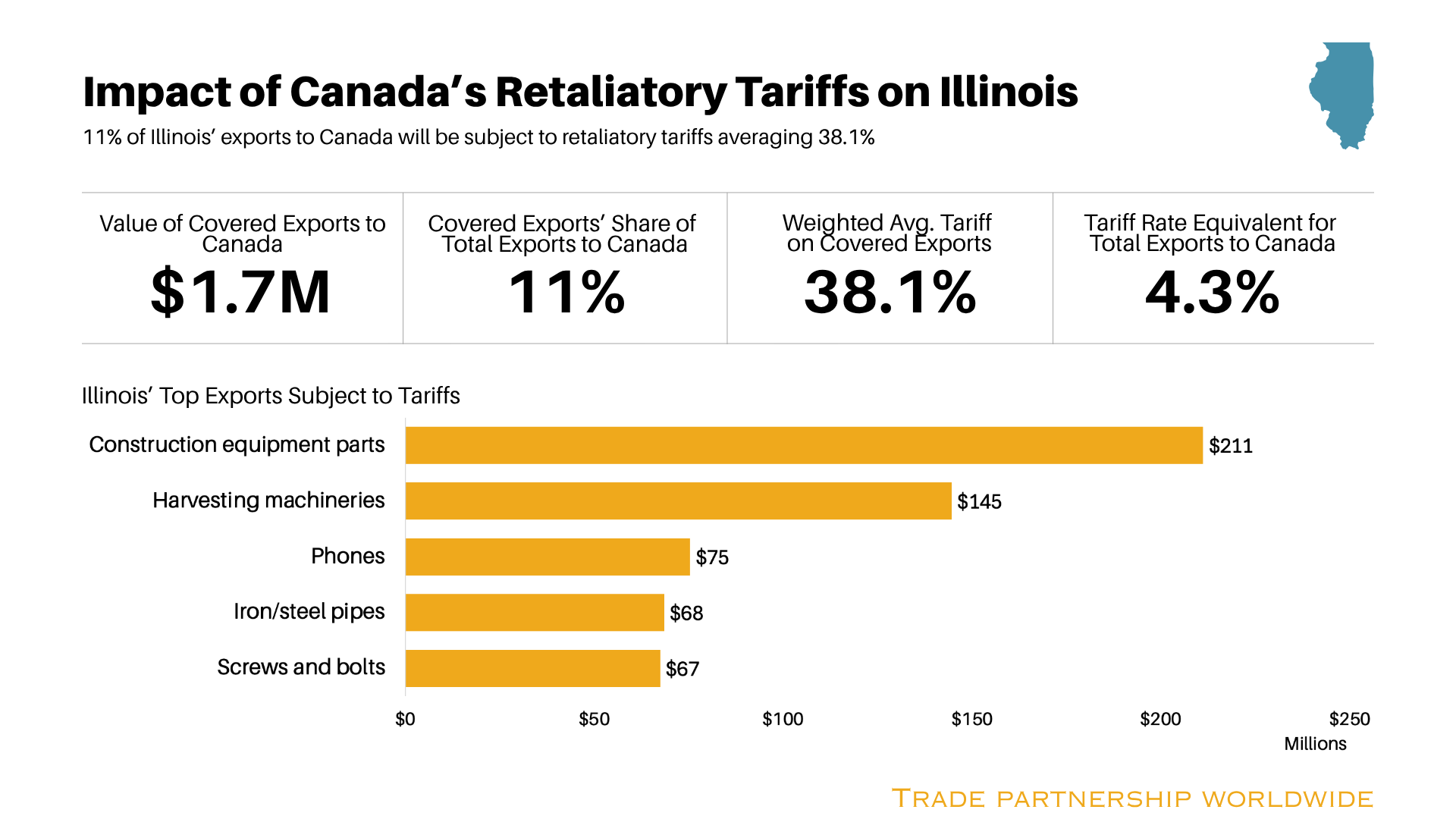
Illinois exported $1.7 billion in covered products to Canada in 2025, making it 3rd among all states. The 38.1% effective rate on covered exports ranks 29th among all states, meaning more of its exports are subject to the maximum 50% rate. Overall, Section 338 retaliation is equivalent to an 4.3% universal tariff on Illinois’ exports to Canada. The top two exports were construction equipment parts and agricultural machinery parts, followed by phones and then iron and steel products.
Miscellaneous high-value exports from other states
Some of the highest-value covered exports come from states that don’t crack the top 3 overall, but those exporters are in no less of a bind from retaliatory tariffs. Examples include:
$335 million in aluminum plates and sheets and $134 million in iron and steel pipes exports from New York
$265 million in railway cars, $207 million in phones, and $131 million in trailers from California
$200 million in toilet paper and $55 million in construction equipment machinery from Wisconsin
$183 million flat-rolled alloy steel, $146 million in clad, flat-rolled non-alloy steel, and $114 million in screws and bolts from Michigan
$161 million in phones, $119 million in construction equipment machinery, $89 million in radiators from Texas
$151 million in carpets, $89 million in aluminum plates and sheets, and $79 million in liquid pumps from Georgia
$122 million in copper wire and $92 million in perfumes, cosmetics, and hair preparations from New Jersey
$108 million in lad, flat-rolled non-alloy steel, $78 million in copper wire, and $76 million in insulated wire from Indiana.
The states with the lowest value of exports subject to retaliation
This is actually quite boring and not worth going into much detail. Hawaii has the lowest value of covered exports due to the fact that it exports very little goods to Canada in the first place. Even if 100% of Hawaii’s exports were covered, it still would rank in the top 3 least-impacted states by value. Alaska had the 2nd-lowest value of exports covered ($5.3 million), followed by Delaware ($14 million) and New Mexico ($15 million).
Summary
The political salience of the states from an export value perspective seems much higher, even if these states export a higher share of products exempt from Canada’s retaliation for U.S. Section 338 tariffs. A number of these states — Pennsylvania, Ohio, Michigan, Texas, Georgia — are viewed as key battlegrounds for control of the House and Senate after the November elections.
Check back tomorrow for our analysis on how Canada’s revision of the tariff list changed the expected impacts on U.S. exports to Canada.